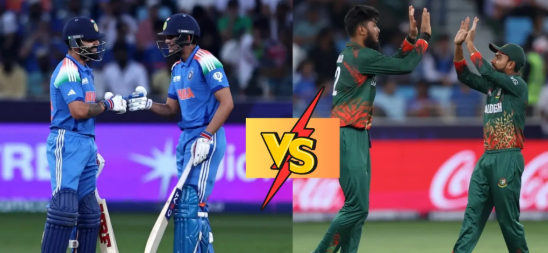
The rivalry between the Bangladesh National Cricket Team and the India National Cricket Team has transformed from a one-sided contest into one of the most emotionally charged and competitive rivalries in modern cricket. Fueled by passion, dramatic finishes, and rising talent, this timeline captures how Bangladesh evolved into a serious challenger against a dominant India.
India posted 168/6; Bangladesh collapsed to 127. Early breakthroughs by Indian pacers and middle-order acceleration by Suryakumar Yadav sealed a 41-run win.
ICC Champions Trophy 2025, Feb 20, 2025
ODI
Bangladesh scored 228; Shubman Gill anchored India’s chase with a classy fifty. Clinical finishing helped India win by 6 wickets.
3rd T20I, Oct 12, 2024, Hyderabad
T20I
Sanju Samson smashed 111 off 47 balls as India posted a record 297/6. Bangladesh managed only 164/7; Ravi Bishnoi picked 3 wickets.
2nd T20I, Oct 9, 2024, Delhi
T20I
India reached 221/9; Nitish Kumar Reddy’s all-round show (bat + bowl) restricted Bangladesh to 135/9. India won by 86 runs.
1st T20I, Oct 6, 2024, Gwalior
T20I
Arshdeep Singh’s fiery 3/14 bundled Bangladesh for 127. India chased comfortably in 11.5 overs.
T20 World Cup 2024, Jun 22, 2024
T20I
India powered to 196/5; Bangladesh replied with 146/8. Rain-affected game ended in a 50-run Indian victory.
2nd Test, Sep 27–Oct 1, 2024, Kanpur
Test
Yashasvi Jaiswal’s quick fifties guided India to chase 95. Bangladesh fought hard in first innings but fell short.
1st Test, Sep 19–22, 2024, Chennai
Test
Ravichandran Ashwin’s masterclass (113 runs + 6/88) dismantled Bangladesh twice. India won by 280 runs.
ODI World Cup 2023, Oct 19, 2023, Pune
ODI
Virat Kohli’s masterclass helped India chase 261/3 comfortably against Bangladesh’s 256/8.
Asia Cup 2023 Super Four, Sep 15, 2023, Colombo
ODI
Shakib Al Hasan’s all-round brilliance (80 runs + 1 wicket) helped Bangladesh defend 265 and win by 6 runs – their rare victory in the rivalry.
Player of the Match & Key Performers
Match & Date
Player of the Match
Key Performers (India)
Asia Cup 2025 T20I
Not specified in records
Suryakumar Yadav (quick fifty)
Champions Trophy 2025 ODI
Shubman Gill
Shubman Gill (fifty in chase)
3rd T20I, Oct 12, 2024
Sanju Samson
Sanju Samson (111 off 47), Ravi Bishnoi (3 wickets)
2nd T20I, Oct 9, 2024
Nitish Kumar Reddy
Nitish Kumar Reddy (all-round), Hardik Pandya
1st T20I, Oct 6, 2024
Arshdeep Singh
Arshdeep Singh (3/14)
T20 World Cup 2024
Not specified
Rohit Sharma & Suryakumar Yadav
2nd Test, Kanpur 2024
Yashasvi Jaiswal
Yashasvi Jaiswal (quick fifties), Indian spinners
1st Test, Chennai 2024
Ravichandran Ashwin
Ravichandran Ashwin (113 + 6/88), Jasprit Bumrah
ODI World Cup 2023
Virat Kohli
Virat Kohli (unbeaten knock)
Asia Cup 2023
Shakib Al Hasan
–
Match Result Breakdown
Match & Date
Format
Winner
Result Margin
Toss Winner & Decision
Asia Cup 2025, Sep 24
T20I
India
41 runs
–
Champions Trophy 2025, Feb 20
ODI
India
6 wickets
Bangladesh batted first
3rd T20I, Oct 12, 2024
T20I
India
133 runs
India batted first
2nd T20I, Oct 9, 2024
T20I
India
86 runs
India batted first
1st T20I, Oct 6, 2024
T20I
India
7 wickets (49 balls left)
Bangladesh batted first
T20 World Cup 2024, Jun 22
T20I
India
50 runs
Bangladesh batted first
2nd Test, Kanpur 2024
Test
India
7 wickets
–
1st Test, Chennai 2024
Test
India
280 runs
Bangladesh fielded first
ODI World Cup 2023, Oct 19
ODI
India
7 wickets
–
Asia Cup 2023, Sep 15
ODI
Bangladesh
6 runs
India fielded first
Early Encounters and India’s Complete Control (1988–2006)
In the early years, matches between Bangladesh and India were largely dominated by India. Bangladesh, still developing its cricketing structure, struggled to compete against India’s experienced and well-balanced squad. From their first meeting in the Asia Cup to early bilateral series, India consistently outperformed Bangladesh in all departments. Bangladesh gained Test status in 2000, but even then, results heavily favored India. These matches, however, were crucial learning experiences for Bangladesh, exposing them to high-level cricket. India’s strong batting lineup and disciplined bowling ensured comfortable victories. This phase established the foundation of the rivalry, though it was clearly one-sided, with Bangladesh focusing on growth and improvement rather than immediate success.
Period
Matches
Dominant Team
Key Feature
1988–1999
ICC Events
India
Experience Gap
2000–2006
Early Tests
India
One-sided Matches
The Shock That Changed Everything (2007 World Cup)
The turning point in this rivalry came during the 2007 ICC Cricket World Cup, when Bangladesh stunned India with a historic victory. This match changed the perception of Bangladesh cricket forever. It was no longer seen as just an emerging team but as a side capable of defeating top nations. The win boosted Bangladesh’s confidence and ignited belief among players and fans. For India, it was a wake-up call, highlighting the growing competitiveness of associate teams. This moment became a defining chapter in the rivalry, marking the beginning of a new era where Bangladesh started to challenge India more seriously.
Year
Event
Winner
Highlight
2007
World Cup
Bangladesh
Historic Upset
Rising Confidence and Competitive Series (2008–2015)
Following their World Cup success, Bangladesh began to show consistent improvement. Matches against India became more competitive, especially in limited-overs formats. Bangladesh’s batting lineup grew stronger, and their bowlers developed the ability to challenge top teams. While India still maintained an overall edge, Bangladesh started winning key matches, particularly in home conditions. The rivalry became more engaging, with close finishes and high-pressure moments. This period saw Bangladesh transition from underdogs to genuine contenders, making their clashes with India more exciting and unpredictable.
Year Range
Key Feature
Dominant Team
Highlight
2008–2012
Improvement
India
Close Matches
2013–2015
Bangladesh Rise
Mixed
Competitive Series
High-Drama Matches and ICC Tension (2016–2019)
Between 2016 and 2019, the rivalry reached new heights with several high-pressure matches in ICC tournaments and Asia Cup finals. One of the most memorable encounters came in the 2016 T20 World Cup, where India secured a thrilling last-over victory. These matches were filled with tension, emotion, and dramatic moments. Bangladesh came close to defeating India multiple times, proving their growing strength. India’s experience often proved decisive, but Bangladesh’s fearless approach made every match unpredictable. This era turned the rivalry into one of the most exciting in international cricket.
Year
Event
Winner
Highlight
2016
T20 World Cup
India
Last-over Thriller
2018
Asia Cup Final
India
Narrow Win
2019
World Cup
India
Competitive Clash
Modern Era: Balanced Battles and Mutual Respect (2020–Present)
In recent years, the rivalry has become more balanced and mature. Bangladesh continues to improve with a strong core of experienced players and emerging talent. India remains a dominant force globally but faces tough competition from Bangladesh, especially in subcontinental conditions. Matches are now closely contested, often going down to the final overs. The rivalry is no longer about dominance but about competition, strategy, and execution. Both teams respect each other’s strengths, and fans eagerly anticipate their encounters across formats.
Year
Format
Winner
Event
2021
Bilateral
Bangladesh
Home Success
2022–2023
Multi-format
Mixed
Balanced Rivalry
2024–Present
All Formats
Ongoing
Competitive
Legendary Players and Match-Winning Heroes
The Bangladesh vs India rivalry has been shaped by iconic players who have delivered unforgettable performances. India’s legends like Sachin Tendulkar and Virat Kohli have dominated many matches, while Bangladesh has relied on stars such as Shakib Al Hasan and Mushfiqur Rahim. These players have defined key moments with their brilliance under pressure. Their contributions have added excitement, emotion, and intensity to the rivalry, making it a favorite among cricket fans.
Player
Team
Role
Contribution
Sachin Tendulkar
India
Batter
Consistency
Virat Kohli
India
Batter
Match Winner
Shakib Al Hasan
Bangladesh
All-rounder
Key Performer
Mushfiqur Rahim
Bangladesh
Batter
Reliability
Future Outlook and Rivalry Growth
Looking ahead, the Bangladesh vs India rivalry is set to grow even stronger. Bangladesh’s steady rise and India’s consistent excellence ensure competitive matches in the future. With new talent emerging on both sides, the rivalry will continue to evolve. ICC tournaments and bilateral series will provide more opportunities for thrilling encounters. The passion of fans and the intensity on the field make this rivalry one of the most exciting in modern cricket. As both teams push each other to improve, the future promises even more unforgettable moments.
Factor
India
Bangladesh
Impact
Strength
Strong
Improving
Close Matches
Form
Consistent
Rising
Balanced Rivalry
Future
Stable
Growing
Exciting Contests
Conclusion
The timeline of the Bangladesh National Cricket Team vs India National Cricket Team rivalry showcases a journey from dominance to competitive balance. What began as a one-sided contest has evolved into a thrilling rivalry filled with dramatic moments and passionate performances. Bangladesh’s rise has added intensity, while India’s consistency ensures high-quality cricket. Memorable matches, iconic players, and close finishes have defined this contest. As both teams continue to grow and adapt, their encounters will remain highly anticipated. This rivalry represents the spirit of modern cricket competitive, emotional, and unpredictable promising fans more excitement and unforgettable moments in the years ahead.


Leave a Reply